
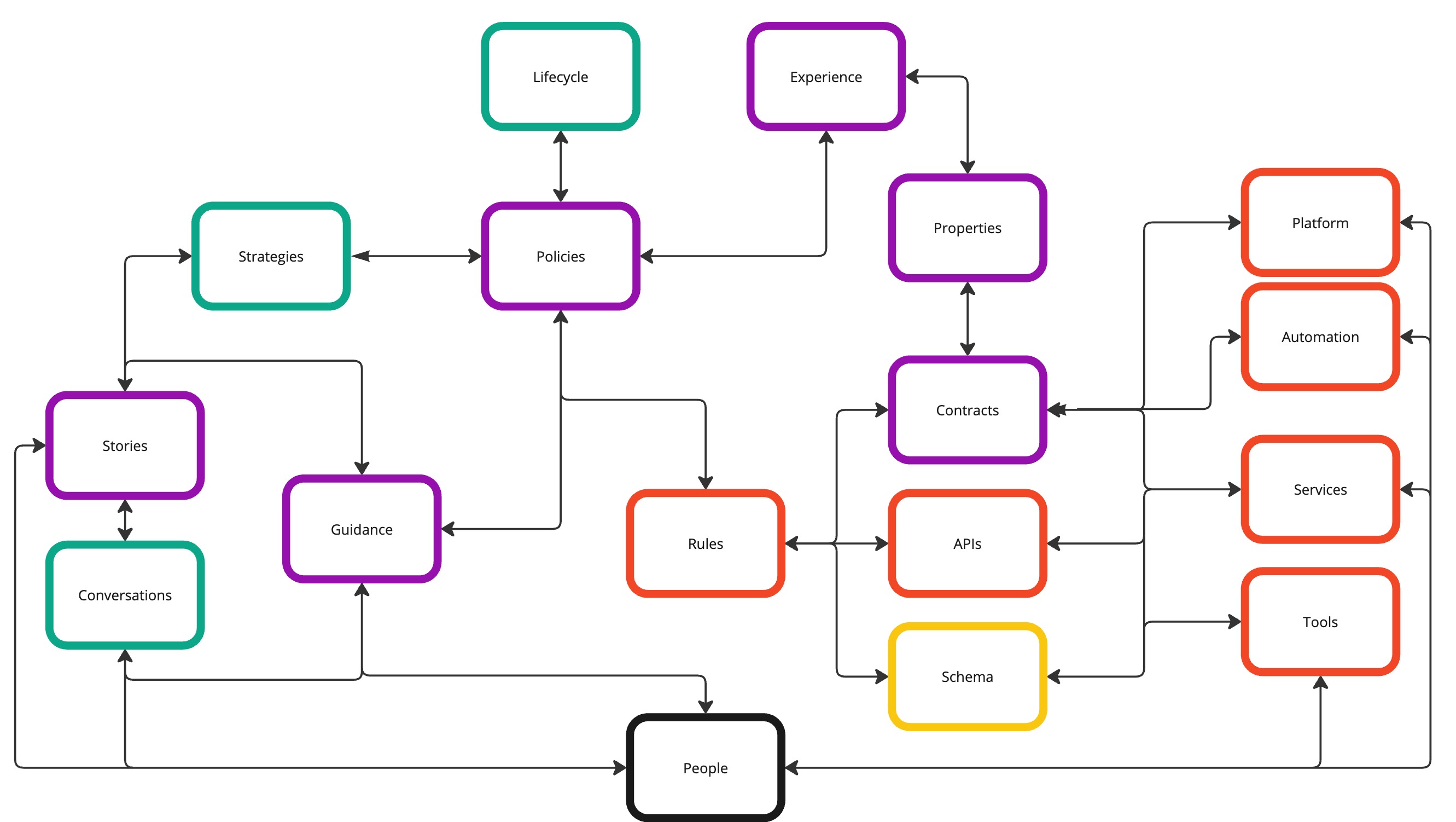
It is really difficult to distill down how to approach enterprise API operations, let alone the governance of API operations into a single bullied list. There are a lot of moving parts already in motion as well as a lot of new building blocks you can apply to achieve the right quality and velocity for any enterprise operations. Some of these moving parts are well known (red), some are less known but ubiquitous (yellow), others are commonly discussed (green), but most lack the connections needed to properly govern the enterprise(purple), with many aspects of APIs ending up negatively impacting people at all levels of the enterprise (black)–to help better illustrate API operations, let’s break down how you govern APIs.
- APIs - You define all of the technical details of your HTTP APIs.
- Schema - You define all of the schemas that are in use across APIs.
- Contracts - You define the business operations surrounding those APIs.
- Experiences - You define the meaningful experiences of people.
- Properties - You define what the properties of those experiences are.
- Lifecycle - You define in what order people are encountering experiences.
- Rules - You define the rules that identify the patterns and anti-patterns.
- Policies - You define business reasons that make patterns or anti-patterns.
- Strategies - You define business strategies for why you would govern APIs.
- People - You define who the people are involved with APIs at all levels.
- Conversations - You have conversations with the people involved with APIs.
- Guidance - You define guidance for the people who are involved with APIs.
- Stories - You tell stories about aspects of API operations to people involved.
- Tools - You define all of the open source tooling used as part of API operations.
- Services - You define all of the commercial tooling used as part of API operations.
- Automation - You define what aspects of API operations can be automated.
- Platform - You define what you are building as a platform to support API operations.
Then you repeat, with the inputs and outputs of API governance living and perpetually being refined as machine-readable artifacts that live in Git repositories. The red boxes are very much what API governance gets defined as today, with green being areas being common talking points, but rarely will actually connect in any meaningful way that will impact operations. Schema and people are the essential intelligence across everything, and the stories, policies, experience, properties, contracts, and guidance are needed to connect the dots and bring perpetual balance to API governance, allowing you to define the right quality and velocity for the enterprise in any given moment.

