If you’re learning how APIs work, testing an AI agent’s tool calls, or just want real data for a demo, the hardest part is often signing up. Every one of the APIs below works without a key, an account or a credit card. You paste the example URL into a browser or curl and get data back.
I called every example request on November 9, 2026, with no key, and each one returned real data. They’re taken from the APIs.io playground, a curated list of APIs that are safe to experiment with. Calling them can’t move money, send a message or touch anyone’s personal data.
Try one first
The simplest way to see what an API is: open this in your browser.
https://api.frankfurter.dev/v1/latest
You’ll get the current euro reference exchange rates back as JSON. That’s an API call: a URL, a request, and structured data you could use in code, a spreadsheet or an agent.
The list
Money and the economy
- Frankfurter: foreign exchange reference rates, current and historical. Try
https://api.frankfurter.dev/v1/latest. - Bureau of Labor Statistics: US employment, wages, prices and productivity data. Try
https://api.bls.gov/publicAPI/v2/surveys. Without a key you get a smaller daily allowance, and a free registration raises it.
Weather, water and energy
- Yr (Norwegian Meteorological Institute): weather forecasts for anywhere on Earth. Try
https://api.met.no/weatherapi/locationforecast/2.0/compact?lat=40.71&lon=-74.01. It requires a User-Agent header that identifies you, such as your app name and an email address. Browsers send one automatically; in code, set your own. - USGS Water Services: US streamflow, groundwater and water-quality observations. Try
https://api.waterdata.usgs.gov/ogcapi/v0/collections/agency-codes. - Carbon Intensity API: how clean Great Britain’s electricity grid is right now, with forecasts. Try
https://api.carbonintensity.org.uk/intensity. - Elexon: UK electricity market data, covering settlement, generation and demand. Try
https://data.elexon.co.uk/bmrs/api/v1/balancing/acceptances/all/latest.
Words, research and games
- Datamuse: rhymes, synonyms and words that sound alike. The tiny responses make it good for chaining calls. Try
https://api.datamuse.com/words?rel_rhy=code&max=3. - arXiv: metadata for millions of research preprints in physics, maths and computer science. Try
https://oaipmh.arxiv.org/oai?verb=Identify. It returns XML, not JSON. - Scryfall: every Magic: The Gathering card. It’s large, clean and generous, which makes it a good first API to explore. Try
https://api.scryfall.com/bulk-data.
For developers
- OpenAPI Generator: generates client SDKs from an OpenAPI file. Try
https://api.openapi-generator.tech/api/gen/clientsto see the languages it supports. I wrote more about what OpenAPI is here.
Be a good guest
“Free and no key” doesn’t mean “unlimited”. These are mostly run by public institutions and open-source communities:
- Keep request volumes modest.
- Cache responses instead of calling every second.
- Set a User-Agent that says who you are.
- Read each provider’s terms before building something people depend on.
If you need guaranteed uptime or higher limits, most of them offer a free registration or a paid tier.
Finding more
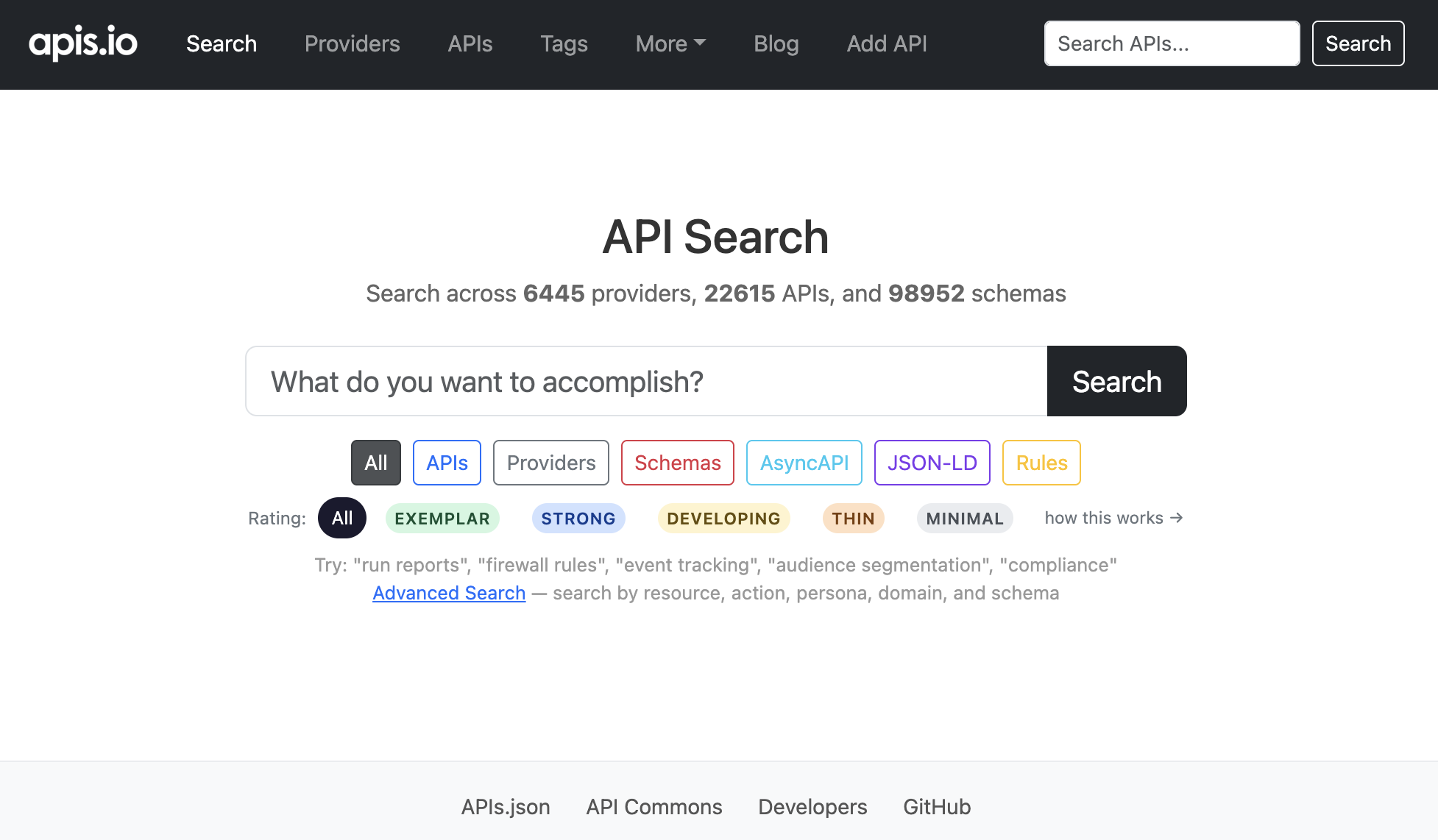
APIs.io indexes tens of thousands of APIs. The playground is the starting set, re-checked so the examples keep working. If you’re connecting an AI assistant, the APIs.io MCP server offers the same list as a tool, so an agent can find a safe API to practise on by itself.
When you’re ready for APIs that need a key, the OpenAI, Twilio and DocuSign pricing breakdowns cover what the commercial ones cost.